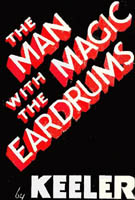
The Man With the Magic Eardrums
Project Bartleby has not gotten around to digitizing Keeler yet. So to give you a rough idea of what a Keeler novel encompasses, here is a synopsis of The Man With the Magic Eardrums (1939).
Bookmaker Mortimer Q. King returns to his Minneapolis home in the middle of the night to find a burglar, Peter Givney, entering an upstairs window. King pulls a gun on Givney and demands how he knew the house would be deserted. Givney shows him a clipping from the newspaper (the first of several that advance the plot) that claims that King is in a sanitarium in Virginia and that his wife, Laurel, is in sackcloth and ashes for her annual three-day novena in memory of her father at the Convent of the Sisters of St. Ethelreda in Milwaukee. The story about King being in the sanitarium, however, was a lie given out by the Kings to confuse subpoena servers, who want King to appear before an upcoming Senate hearing on the abolishment of racetrack betting.
The burglar alludes to a seemingly unrelated chain of events then making front-page news. In London, murderess Jemimah Cobb is due to be hung at sunrise. Jemimah, who is black, has murdered her Chinese lover. Cobb is also the madam of England's most notorious whorehouse, specializing in deformities and freaks. In a last-ditch attempt to save herself, Cobb has threatened to reveal the identity of the white man in America to whom she is secretly married. This information, she swears, will somehow cause a war between the United States and England if she is executed.
Chapter One ends on the revelation that Mortimer King is the white American legally married to Jemimah Cobb.
Years previously, King married Cobb under the influence of voodoo drugs. Since the newspapers had erroneously reported Cobb's death years ago, King never got a divorce from Cobb before marrying Laurel, nor (in view of Laurel's Southern background) did he have the nerve to tell Laurel about the marriage.
In a vain attempt to get her sentence commuted, Cobb revealed the solution of the "Mulkovitch riddle" to the British Home Secretary. This is a mystery that had been puzzling British police for years: Nikolai Mulkovitch, a bearded Russian anarchist of about 40, was under observation by two American agents on suspicion of dynamiting the American Embassy. Mulkovitch was trailed to Cobb's whorehouse in Exham Heath, London. With both entrances under surveillance the British police closed in to arrest Mulkovitch. Inside they found Cobb and five prostitutes -- French Theodora, cross-eyed Gertrude, Koko from Singapore, hunchbacked Minnie, and Katie, a German with seven fingers on each hand. Mulkovitch was not there. The police looked under the beds, in the walls, and in all possible hiding places. The furnace was checked for evidence of cremation, but not so much as a button or belt buckle was found. Finally, the owner of the building, a religious man appalled at its use, demolished the structure before the eyes of the police. No secret panels or chambers were found. Cobb and each of the prostitutes were identified by an officer who raided the house previously. Each person seized in the raid was isolated from the others and interrogated separately. Each seemed genuinely not to know what had happened to Mulkovitch. Mulkovitch was never seen again, alive or dead. The Home Secretary vowed to publish Cobb's explanation of the puzzle in his memoirs.
King asks the burglar how he planned to open the safe, a "burglar-proof" five-dial Nixon-Duvall model with no tumblers. Givney explains that he is virtually stone-deaf and hears only with hearing aids. By accident he was given a set of hearing aids that work so well that he can hear noises normally inaudible. Givney discovered that he can even hear slight magnetic stresses in the wall of safe caused by the electric mechanism and thus can open the safe about half the time.
King makes a deal with Givney: If he can open the safe, King will not call the police but will allow Givney to escape. In fact, King is anxious to get the safe open because he returned home with the intention of stealing his own wife's jewels. The jewels and the house are in Laurel's name. King has suffered a series of business reverses in his bookmaking operations and had actually been sleeping in flophouses in San Francisco. He has not told his wife this, however, because she had always said that if he ever goes broke, it would be God's sign of disapproval of gambling, and she would not help him. King wanted to use the jewels to finance a new bookmaking operation, but while he was in San Francisco Laurel had the safe replaced with the burglar-proof model without telling him the combination.
Just after King makes this proposal to Givney, he receives a phone call from Sol Steenburg, an attorney from Buffalo, who offers King $500 for the human skull he keeps as a good luck charm. Steenburg, calling from a nearby drugstore, wants to come over immediately, but insists that they must speak in private. King has Givney take out his hearing aids (so that he won't be able to eavesdrop) and hide in the closet. King hides the skull in the wastebasket in case Steenburg intends to take it by force.
Steenburg arrives and tells his story. He is the son of Rabbi David Steenburg, who happens to be an expert on the evils of racetrack betting and is scheduled to appear at the same Congressional hearing that King is being subpoenaed to attend. In one of the many subplots that is never resolved, Steenburg is representing Soo Ching, a Chinese laundry owner who is suing the Buffalo Trust and Savings Bank, claiming he is legal owner of the land on which their new skyscraper is constructed. According to Soo Ching, his grandfather, Soo Long, was given the land by Christopher Schurz, a grateful customer disgusted with the sawtooth edges other laundries left on his shirts' detachable cuffs. The customer gave Soo Long a deed, which was discovered hidden in the wrapping of an ironing board 55 years later by Soo Ching. The deed was made out to "S. Long." By coincidence, however, Christopher Schurz also had a nephew by the name of Samuel Long and, on his deathbed, forgot the previous deed in his delirium and made out another deed in the name of his nephew, who he also carelessly referred to as "S. Long."
Steenburg needs the skull because, unknown to King, it is the only shred of physical evidence of the gangland-style murder of "Blinky," a one-eyed gigolo. Steenburg has a client, "Big Shoes," who was unwittingly involved in the murder of Blinky. Another gangster, Cokey, a drug addict, knows of Big Shoes' involvement. It is feared that the New York City police will soon arrest Cokey. When they do, Steenburg says, they will bribe Cokey with shots of morphine and, in the agonies of withdrawal, he will tell them about the murder of Blinky.
The principle of corpus delicti identifactus operating in Wisconsin and Minnesota requires that the identity of a dead body or remains be established before a charge of murder can be brought. The skull can be identified as that of Blinky because Blinky suffered from an unusual facial neuritis and a set of X-rays of his head are on file at a medical institute.
Big Shoes has a criminal record, and because of the Habitual Criminal Acts of various midwestern states, he can be sentenced to life imprisonment for the most trifling transgression if he ever leaves the state of Illinois. The skull was dug up by Henry Speevy, a Wisconsin farmer, who happened to be a hunting partner of one of King's employees. This employee mentioned King's belief in superstitions, such as never allowing his picture to be taken and belief that any part of the skeleton of a murdered man was good luck. Since a bullet-hole proved the skull was from a murdered man, Speevy sold it to King.
King also believes, however, that a good luck charm that has been altered is bad luck. And, says Steenburg, the skull has been drilled without King's knowledge. For King's maid, Rozalda, lent it to a friend, Dr. Stefan Sciecinskiwicz, for a mock operation. Sciecinskiwicz's brother is the notorious gangster Two-Gun "Polack" Eddy, suffering from a painful pus-impacted sinus. Since the police had requested that doctors report anyone with this condition, Eddy had to go to his brother for the operation, even though Sciecinskiwicz had not performed sinus operations in years. Sciecinskiwicz decided that he needed to perform three practice operations before operating on Eddy, so he obtained two skulls (one from Rozalda) and one cadaver head to work on. King's skull was returned but the "operation" left a drill hole and, in King's view, ruined it as a talisman.
This story is interrupted by an anonymous phone call warning King that the Minneapolis Morning Bugle has learned he is the husband Jemimah Cobb will name and has already set the story in type, with his name in the headline and a candid snapshot of King four columns wide. This is a double whammy for King, for not only does he feel it is bad luck to have his picture taken, but a legal agreement with his wife requires that he do everything possible to keep his name out of the papers.
King tells Steenburg that the skull (actually in the wastebasket) has been sent to a friend who needed it for a Halloween party. Steenburg proposes that King or a messenger go to Chicago with the skull in a crimson shoe box with holes punched in it (so that, to passers by, it will be thought to contain a pet lizard or horned toad) and meet Big Shoes outside the Quincy Street post office. Big Shoes will look in the shoe box and give King or the messenger $500. This agreed, Steenburg leaves.
King lets Givney out of the closet. King notices another newspaper clipping in Givney's pocket. It reveals that Givney was arrested for making fun of "Long John" van Critchford, a 7-foot-high traffic officer, who is the cousin of King's wife Laurel and a Harvard-educated Ph.D.
King tells Givney of his financial plight. In San Francisco, he was down to his last five dollars when he found a local bookie offering extremely favorable odds on a long shot. He bet two dollars on a parlay paying off 100 to 1. As he left the office he met a man asking for an inside tip. The man said he was dying of cancer and wanted passage to Australia where his only relative ran a nursing home and could make his last days a comfortable as possible. King told him about the bet. The bet came in, and the man was so grateful that he repaid King by giving him information that would allow him to rob his own wife -- for the man was actually Alonzo Hetchel, who had been hired by Laurel in Minneapolis as gardener in King's absence.
Not knowing of the new safe, Hetchel and King thought he only needed to make sure that the servants, Rozalda and Otto, were out of the house at the same time on some night when Laurel was at the convent. While employed in the King household, Hetchel learned that both Rozalda and Otto had love interests in other cities. Both lovers were married and thus communicated to Rozalda and Otto only by typewritten letter. Gretchen, Otto's German mistress, wrote in German on an L.C. Smith typewriter with red ribbon; Tomacek, Rozalda's lover, wrote in Polish on an Underwood machine. King found a former professor of languages on San Francisco's skid row and had him compose two letters, typing them on the respective machines in typewriter dealers' shops. The letters told Otto and Rosalda to meet their lovers on the evening of October 22nd in different cities. Thus King came home expecting the house to be empty, his plan foiled only by the new burglar-proof safe.
King planned to stop Cobb from revealing him as her husband. In the safe is an emerald ring of Laurel's that he can sell, no questions asked, to an eccentric emerald collector for $1000 cash. This money King plans to wire to Britain to a friend named "Horses," a former employee and ex-actor who is so deathly afraid of being burned alive that he carries a vial of cyanide on his watch chain to swallow should he ever be trapped in a burning building.
King knows that Jemimah Cobb, in turn, is so afraid of being lynched that she will do anything to avoid it. During their brief stint as man and wife, she told King that if she were ever facing the gallows she would tell the police that she has a brother. This would allow friends to send someone posing as her brother to give her a vial of poison. King's $1000 from the emerald would induce Horse (who is black) to pose as Jemimah's brother and slip her the poison.
These elaborate plans come to naught, however. Givney, after learning King's story, feels he has the upper hand and balks at opening the safe. King sweetens the deal by offering Givney the chance to take the skull to Chicago in the crimson shoe box and get the $500. Givney, however, did not overhear the conversation with Steenburg and suspects that it is a trick.
Meanwhile, the hour of Cobb's execution is drawing closer. King calls up a late-news service of the newspaper. He asks an operator for any new developments on the Pentonville Prison matter -- but the operator hears only the first part of his request and connects him to a recording of developments about a certain William Penton. Penton, a journalist fired by the morning newspaper, broke into the Minneapolis Telephone Exchange and tapped into an experimental service that allows authorities to call and address every phone in the Minneapolis area simultaneously in time of emergency. Penton used this service to call every man in Minneapolis and tell them that they would be named as Jemimah Cobb's husband in the next issue of the Morning Bugle. This was the anonymous phone call that King received earlier.
Meanwhile, the British Home secretary reveals the solution to the Mulkovitch Riddle: Mulkovitch was actually a circus bearded lady, Theodosia Brianza, twin of Cobb's French prostitute Theodora. Theodosia's circus ranged through Russia and Poland; she learned some English from a "human skeleton," Oliver Peebe. Anxious to see her sister, Theodosia got a passport under a man's name so that she could travel without having to shave her beard. Theodosia/Mulkovitch went to Cobb's whorehouse only to learn the sad news that Cobb had just returned from identifying the body of Theodora at the morgue. Sick of carnival life, Theodora agreed to shave her beard and assume the role of her sister. She took off her cheap Russian man's suit and burned it -- the buttons were celluloid, so there was no telltale evidence in the furnace. When the house's occupants were arrested, Cobb, out on bail, smuggled a razor to Theodora so that she could remain clean-shaven in prison.
Cobb was executed but went mad in her last hours. She named the President of the United States as her husband. At the very end, it is revealed -- so it seems -- that Givney is really Mortimer King, and "King" is a burglar -- who climbs out the window and runs away with the skull and his last two dimes in his pocket.
[Huh?!? Sorry, that's where the novel ends. It turns out that Man With the Magic Eardrums is just the first part of one of those mega-novels that Keeler's publishers demanded he break into smaller pieces. Maybe the next installment makes sense of all this -- or maybe the book after that does.]